Benefits of Registering a Private Limited Company in India
Why Private Limited Companies Dominate Indian Startups: 10 Key Advantages Explained

Introduction
Starting a business in India presents entrepreneurs with a critical decision: which legal structure best serves their vision? Among the various options, sole proprietorships, partnerships, Limited Liability Partnerships, and One Person Companies, the Private Limited Company has emerged as the overwhelmingly preferred choice for serious entrepreneurs. In fact, over 95% of funded startups opt for the Private Limited Company structure, and for good reason.
Registering as a Private Limited Company (Pvt Ltd) is far more than a legal formality. It’s a strategic decision that fundamentally transforms how your business operates, how investors perceive it, and how the law protects you. This comprehensive guide explores the tangible, powerful benefits that make Pvt Ltd company registration the gold standard for Indian entrepreneurs aiming for growth, credibility, and long-term success.
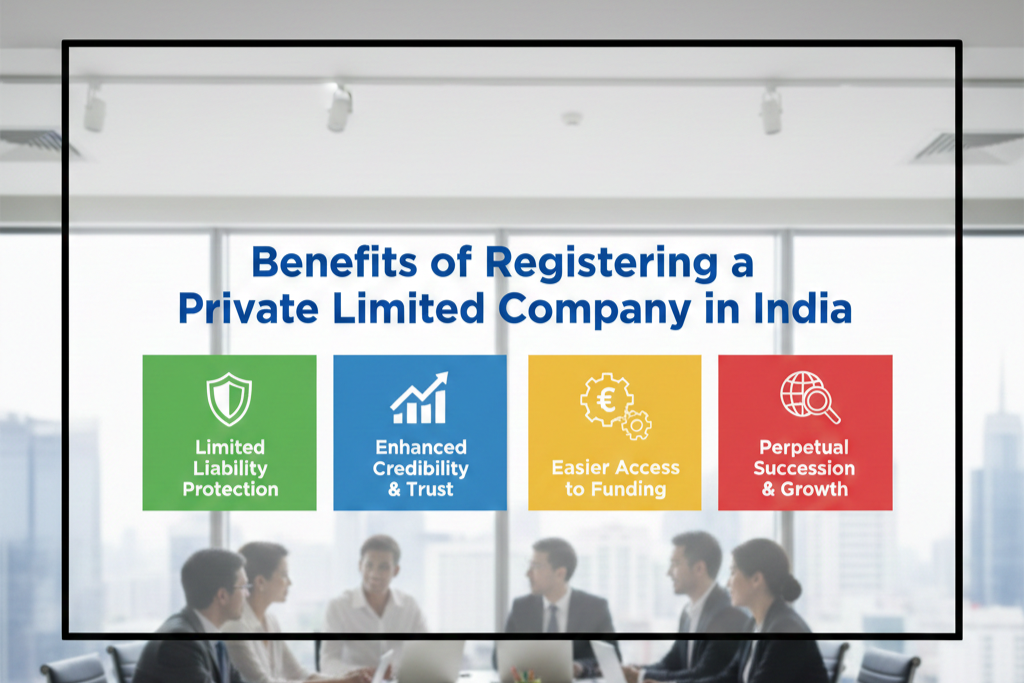
1. Limited Liability: Protecting Your Personal Assets
In a Private Limited Company, the liability of shareholders is strictly limited to the unpaid value of their shares. If the company owes ₹50 lakhs to creditors and your share capital is ₹5 lakhs, your maximum financial exposure is ₹5 lakhs, not your entire personal wealth. Your home, savings, vehicles, and other personal assets remain completely protected, even if the business fails catastrophically.
This protection transforms entrepreneurship from a high-risk personal endeavour into a calculated business venture. It gives you the psychological freedom to take calculated risks, innovate, and scale, knowing that a business failure won’t destroy your family’s financial security.
2. Separate Legal Entity: Operating with Independence and Authority
A Private Limited Company is recognized by law as a completely independent legal entity, distinct and separate from its shareholders and directors. This might sound technical, but the practical implications are profound.
Your company can own property, sign contracts, borrow money, and initiate legal action, all in its own name. This separation creates several critical advantages:
3. Substantial Tax Advantages: Reducing Your Tax Burden
India’s tax framework is deliberately structured to encourage corporate organization, and Pvt Ltd companies benefit significantly from preferential tax treatment.
Lower Corporate Tax Rates: A Private Limited Company is taxed at a flat corporate tax rate of 22% (plus 4% health and education cess) if turnover is below ₹400 crore. In contrast, individual business owners face progressive income tax rates reaching up to 30%, potentially creating massive tax savings.
Expense Deductions: Pvt Ltd companies can deduct legitimate business expenses comprehensively, including salary payments, rent, utilities, marketing costs, travel, professional fees, and depreciation on assets. These deductions reduce taxable income substantially, creating meaningful tax efficiency.
4. Zero Minimum Capital Requirement: Removing Financial Barriers
One of the most liberating changes in Indian corporate law occurred in 2015: the complete elimination of the minimum paid-up capital requirement for Private Limited Companies.
Previously, entrepreneurs needed to deposit at least ₹1 lakh in capital before registration, a significant barrier for many startups. This requirement has been entirely abolished. You can now register a Private Limited Company with virtually any amount of paid-up capital, including ₹1 or even ₹1 per share, depending on your circumstances.
Why This Matters: This change democratized entrepreneurship. Young entrepreneurs, bootstrap founders, and capital-constrained teams can now register as a Pvt Ltd company without the burden of raising ₹1 lakh immediately. You can begin with minimal capital, prove your business model, demonstrate traction, and then raise investor funding later from a position of strength.
Similarly, there is no maximum capital limit. You can raise investments from hundreds of shareholders (up to 200) without any regulatory cap on the total capital raised. This flexibility is essential for growth-stage and scaling companies.
5. Enhanced Credibility and Investor Confidence
The moment you register as a Private Limited Company, your business transforms in the eyes of stakeholders, customers, partners, financial institutions, and investors.
Professional Status: The “Pvt Ltd” designation in your company name signals professionalism, legal compliance, and serious intent. Customers and clients perceive you as a structured, regulated business rather than an informal operation. This enhanced perception directly translates to competitive advantage in sales, partnerships, and brand building.
Government Registry Transparency: All registered Private Limited Companies are listed in government databases maintained by the Registrar of Companies (ROC). This public registration creates authentic, verified information about your company, including ownership structure, directors, financial statements, and compliance status. Banks, investors, and partners can independently verify your legitimacy, dramatically increasing their confidence in dealing with you.
Institutional Funding Access: Venture capitalists, angel investors, and institutional lenders overwhelmingly prefer investing in Pvt Ltd companies. The familiar legal structure, statutory governance requirements, and transparent financial reporting reduce perceived risk. An investor considering your startup will be far more interested if you operate as a Pvt Ltd company than as a partnership or sole proprietorship.
Banking and Vendor Relationships: Banks are more willing to extend business credit to Pvt Ltd companies. Vendors and suppliers trust the formal structure and see lower default risk. Payment terms improve, credit facilities expand, and the cost of capital decreases.
Investor Comfort with Perpetual Succession: Investors know that their investment is protected by the company’s independent legal existence. If a co-founder exits, the company continues. The investor’s shareholding persists regardless of changes in management or ownership, a critical comfort factor for institutional funding.
6. Simplified and Online Registration Process
The Ministry of Corporate Affairs has dramatically simplified Private Limited Company registration through the SPICe+ (Simplified Proforma for Incorporating Company Electronically Plus) system.
The entire registration process is now conducted online, eliminating the need for physical document submission or RoC office visits. The streamlined process typically involves:
- Obtaining a Digital Signature Certificate (DSC) for directors
- Applying for Director Identification Numbers (DIN)
- Reserving the company name
- Drafting Memorandum of Association (MoA) and Articles of Association (AoA)
- Filing all documents through SPICe+ on the MCA portal
- Obtaining the Certificate of Incorporation
The process is remarkably quick, many companies receive their Certificate of Incorporation within 2-4 weeks of application. The cost is minimal (typically ₹4,000-₹8,000 including government fees and professional charges), making it accessible for virtually any entrepreneur.
This ease of registration removes traditional barriers and enables rapid formalization of business ideas into legal entities.
7. Flexible Shareholding Structure
A Private Limited Company requires a minimum of two shareholders and a maximum of 200 shareholders. This balanced structure offers significant flexibility:
For Small Teams: You can start with just two co-founders, both owning shares and serving as directors. As the team grows, you can bring additional employees into the shareholding structure without regulatory burden.
For Larger Investor Groups: You can accommodate up to 200 different shareholders, each with different shareholding percentages, investment amounts, and rights. This flexibility is invaluable when raising capital from multiple angel investors, family offices, or institutional funds.
International Investors: Foreign individuals and corporate entities can be shareholders in your Pvt Ltd company, enabling Foreign Direct Investment (FDI). The Indian government permits 100% FDI in most sectors without prior government approval, opening global funding opportunities.
Founder Dynamics: If a co-founder exits, the transition is clean. Their shares can be bought back or transferred to new shareholders without affecting the company’s operations. The company continues uninterrupted.
8. Attracting and Retaining Top Talent
A formal Pvt Ltd company structure enables sophisticated employee incentive mechanisms that partnerships and sole proprietorships cannot offer.
Employee Stock Option Plans (ESOPs): Pvt Ltd companies can establish Employee Stock Option Plans, allowing employees to purchase company shares at a predetermined price after a vesting period. This transforms employees into shareholders with a long-term stake in company success.
For DPIIT-recognized startups, the rules are particularly favourable: you can grant ESOPs to early employees without excluding them based on typical promoter restrictions (which normally apply for 10 years). This enables startups to offer genuine equity participation, a critical tool for attracting world-class talent in competitive markets.
Long-Term Incentive Alignment: Rather than paying high salaries, growth-stage companies can offer a combination of modest salary plus equity options. If the company succeeds and grows, employees see substantial returns on their equity. This aligns employee incentives with long-term company success and dramatically improves retention.
9. Access to Diverse Funding Sources
The formal structure of a Pvt Ltd company unlocks funding pathways unavailable to other business structures.
Angel Investment: Angel investors, successful entrepreneurs providing early-stage capital, prefer investing in Pvt Ltd companies. The familiar shareholding structure and governance framework make investment agreements simpler and more predictable.
Venture Capital: Venture capital firms almost exclusively invest in Pvt Ltd companies. If you aspire to raise institutional venture funding, Private Limited Company Registration is often a prerequisite.
Bank Loans and Credit: Banks are more willing to extend business loans to formally structured companies. The statutory audit requirements and financial transparency reduce perceived risk, improving loan approval rates and interest rates.
Government Support: If your company qualifies as a DPIIT-recognised startup, you access to government funding schemes, including the Startup India Seed Fund Scheme (up to ₹50 lakh), the Fund of Funds for Startups (₹10,000 crore), and credit guarantees from SIDBI.
10. Compliance Requirements: Building Business Credibility
While compliance requirements might seem burdensome, they actually strengthen your business and market position.
Mandatory Statutory Audit: Every Pvt Ltd company must conduct an annual statutory audit by a qualified Chartered Accountant, regardless of size or profitability. This audit verifies that financial statements are accurate and comply with accounting standards. While this involves cost, it builds credibility with stakeholders and ensures that financial controls are robust.
Regular Financial Reporting: Your company must file audited financial statements and annual returns with the Registrar of Companies within defined timelines. This public financial reporting creates transparency that investors and partners value.
Board Meetings and Governance: Companies must conduct at least four board meetings annually. These formal governance processes, while requiring time, ensure systematic decision-making and risk management.
Conclusion
Registering a Private Limited Company in India is substantially more than a legal requirement; it’s a strategic investment in your business’s credibility, growth potential, and long-term viability. The combination of limited liability protection, tax advantages, perpetual succession, investor credibility, and government support creates a powerful platform for entrepreneurial success.


Easy tips and tricks to clean your sofa at home
The sofa is the center of your living space. Your sofa is a place where … …
Fun Online Entertainment Experience
KP88 – A Comprehensive Look at a Popular Online Gaming Platform Introduction to KP88 …