Regression Testing Trade-offs in Fast-Moving CI Pipelines

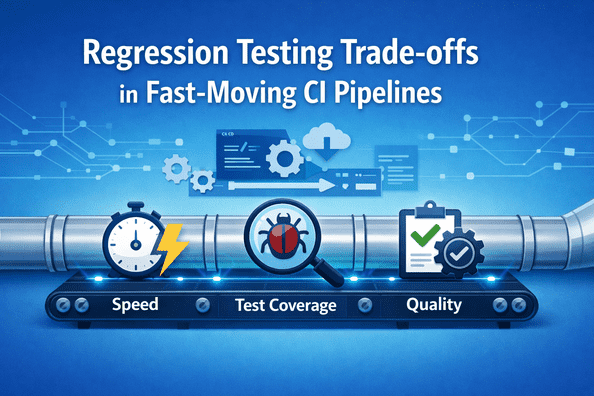
Regression testing plays a critical role in protecting software quality as systems evolve. In fast-moving CI pipelines, however, it also becomes one of the biggest points of tension. Teams want rapid feedback, short build times, and frequent deployments, yet regression testing grows heavier with every new feature, fix, and dependency.
This creates unavoidable trade-offs. Run too many regression tests, and pipelines slow down. Run too few, and defects escape into production. Understanding how to balance regression testing depth with delivery speed is essential for teams operating at high velocity.
Why Regression Testing Becomes Challenging in CI Pipelines
CI pipelines are designed for speed and repeatability. Every commit is expected to trigger builds, tests, and validations automatically. Over time, regression testing suites expand as teams add coverage for past bugs and critical workflows.
Common pressure points include:
-
Increasing test execution time as the codebase grows
-
Flaky tests causing false failures and reruns
-
Limited feedback windows for developers
-
Infrastructure costs for running large test suites
In fast-moving pipelines, regression testing is no longer just a quality concern. It becomes a throughput constraint.
The Core Trade-off: Speed vs. Safety
At the heart of regression testing decisions lies a fundamental trade-off.
-
Faster pipelines enable quicker feedback, more deployments, and faster experimentation
-
Deeper regression testing reduces the risk of functional regressions and production incidents
Optimizing for one often comes at the expense of the other. Teams that prioritize speed may delay or skip regression testing, while teams focused purely on safety risk slowing delivery to a crawl.
The goal is not to eliminate this trade-off, but to manage it consciously.
Why Running All Regression Tests on Every Commit Doesn’t Scale
Early-stage projects can often afford to run full regression testing on every change. As systems mature, this approach breaks down.
Problems with full-suite execution include:
-
Long feedback cycles that interrupt developer flow
-
Increased likelihood of flaky test failures
-
Reduced trust in pipeline results
-
Pressure to bypass CI checks entirely
When regression testing blocks progress too frequently, teams begin treating it as an obstacle rather than a safeguard.
Selective Regression Testing as a Practical Compromise
One common strategy to address pipeline pressure is selective regression testing. Instead of executing the entire suite, teams run tests that are most relevant to the change.
This can be based on:
-
Modified components or services
-
Impacted APIs or workflows
-
Risk level of the change
-
Historical failure patterns
Selective regression testing reduces execution time while still providing meaningful coverage, but it requires discipline and tooling support to avoid blind spots.
Regression Testing at Different Pipeline Stages
Another effective way to manage trade-offs is by distributing regression testing across pipeline stages rather than concentrating it in one place.
Typical patterns include:
-
Lightweight regression tests on every commit
-
Broader regression coverage on pull request merges
-
Full regression suites during nightly or pre-release builds
This staged approach ensures that critical regressions are caught early, while less urgent validations run asynchronously without blocking developers.
The Risk of Over-Optimizing for Speed
Some teams aggressively minimize regression testing to keep pipelines fast. While this may improve short-term velocity, it often introduces long-term costs.
Common consequences include:
-
Subtle regressions surfacing late in production
-
Increased reliance on manual verification
-
Higher incident recovery times
-
Erosion of confidence in releases
Skipping regression testing does not remove risk; it simply shifts it downstream, where failures are more expensive to fix.
Flaky Tests: The Hidden Cost of Regression Testing
Flaky tests amplify the trade-offs in CI pipelines. Even well-designed regression testing suites lose credibility when tests fail intermittently.
Flakiness leads to:
-
Repeated pipeline reruns
-
Ignored failures
-
Reduced trust in test outcomes
In fast-moving pipelines, unreliable regression testing is often worse than limited coverage. Teams must invest in test stability before expanding their suites further.
Regression Testing and Microservices Complexity
Modern CI pipelines often support microservices architectures, where changes in one service can impact many others. Regression testing becomes more complex as service interactions multiply.
Challenges include:
-
Determining which services require regression testing
-
Managing cross-service dependencies
-
Avoiding slow end-to-end test bottlenecks
Here, regression testing trade-offs are not just about quantity, but also about scope and realism.
Using Production Signals to Refine Regression Testing
One way to improve the cost-benefit balance of regression testing is to base decisions on real production behavior.
Teams can prioritize tests that cover:
-
Frequently used user paths
-
Past incident scenarios
-
High-impact integrations
Tools like Keploy help teams generate regression tests from actual runtime traffic, making test coverage more representative without bloating the suite artificially.
Measuring the Right Metrics
To manage regression testing trade-offs effectively, teams need better metrics than test count or coverage percentage.
More useful signals include:
-
Regression test execution time per pipeline stage
-
Failure detection rate versus false positives
-
Mean time to feedback for developers
-
Correlation between skipped tests and production defects
These metrics help teams evaluate whether regression testing is delivering real value relative to its cost.
When Slower Pipelines Are the Right Choice
Not all pipelines need to be fast at all times. For high-risk changes, regulatory environments, or major architectural shifts, slower pipelines with deeper regression testing may be justified.
The key is intentionality. Slower feedback should be a conscious decision based on risk, not an accidental consequence of unchecked test growth.
Conclusion
Regression testing in fast-moving CI pipelines is a balancing act, not a fixed rulebook. Teams must continuously navigate trade-offs between speed, safety, and confidence.
Effective regression testing strategies focus on relevance, stability, and intelligent distribution across pipeline stages. Rather than running everything everywhere, successful teams run the right tests at the right time.
When managed well, regression testing supports rapid delivery instead of resisting it. When ignored or overextended, it becomes a bottleneck. The difference lies in how thoughtfully teams approach the trade-offs.


Easy tips and tricks to clean your sofa at home
The sofa is the center of your living space. Your sofa is a place where … …
Fun Online Entertainment Experience
KP88 – A Comprehensive Look at a Popular Online Gaming Platform Introduction to KP88 …