When Should Full and Final Settlement Be Paid After Resignation?
When Should Full and Final Settlement Be Paid After Resignation?

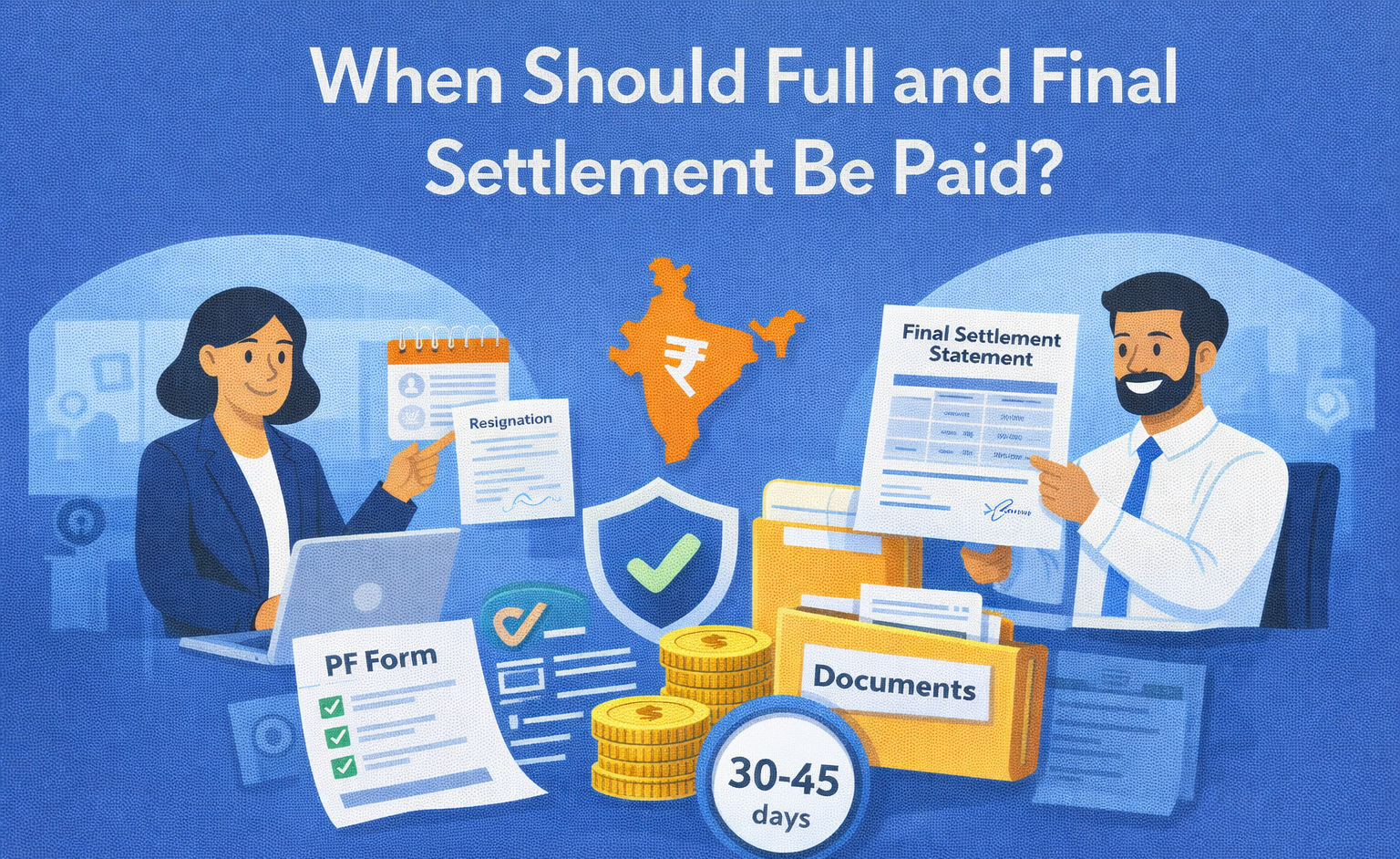
Resignation marks the formal end of an employee’s journey with an organization, but the relationship doesn’t fully conclude until the full and final settlement is completed. One of the most common questions employees ask after submitting their resignation is when they will receive their full and final settlement.
For employers and HR teams, timely processing of full and final settlement is not just a best practice but also a legal and ethical responsibility. Delays can lead to dissatisfaction, disputes, and reputational damage. This blog explains when full and final settlement should be paid after resignation, applicable timelines in India, and factors that may affect the payout.
What Is Full and Final Settlement?
Full and final settlement refers to the process through which an employer clears all pending dues payable to an employee at the time of exit. This includes salary up to the last working day, leave encashment, bonuses or incentives if applicable, gratuity, reimbursements, and deductions such as taxes, loans, or notice period shortfall.
Once the settlement is completed and paid, the employer-employee relationship officially ends from a financial and legal perspective.
When Should Full and Final Settlement Be Paid After Resignation?
In India, there is no single central law that defines an exact deadline for paying full and final settlement in all cases. However, labour regulations and court rulings emphasize that settlement should be completed within a reasonable timeframe after the employee’s last working day.
Most organizations follow a standard practice of completing full and final settlement within 30 to 45 days from the last working day. This period allows HR and payroll teams sufficient time to complete exit formalities, verify data, and process payments accurately.
Legal Perspective on Full and Final Settlement Timelines
Although full and final settlement is not explicitly defined under one law, multiple labour regulations indirectly govern payment timelines.
The Payment of Wages Act, 1936, requires wages to be paid within prescribed timelines, especially in cases of resignation or termination. Many state-specific Shops and Establishments Acts mandate employers to clear all dues within a defined period, typically ranging from a few days to one month after separation.
For workmen covered under the Industrial Disputes Act, delayed payment of dues may be considered an unfair labour practice and could result in disputes or legal action. Even for employees not covered under these acts, unreasonable delays can still attract legal scrutiny.
Factors That Influence Settlement Timelines
Several operational factors can affect how soon full and final settlement is paid after resignation.
Completion of the notice period plays a major role, as settlement usually begins only after the last working day. Exit clearance, including asset handover and access revocation, can also impact timelines. Any pending company property must be returned before settlement is processed.
Leave balance verification is another critical factor. Payroll teams must validate attendance records and unused leave data to calculate leave encashment accurately. Payroll cut-off dates may also cause settlement to be processed in the next salary cycle.
In cases where gratuity is applicable, additional approvals and compliance checks may extend the settlement process slightly.
Common Timeline Followed by Organizations
A typical full and final settlement timeline followed by many organizations includes completion of the last working day, exit clearance within one to two weeks, payroll and finance verification within the next few weeks, and final payout credited within 30 to 45 days.
Companies that use automated HR and payroll systems often complete the process faster, sometimes within 15 to 30 days.
Also Read: Full and Final Settlement in HR: Everything Employees Should Know
What If Full and Final Settlement Is Delayed?
Delayed settlement can create several issues for employers. Employees may raise complaints with labour authorities or send legal notices demanding payment. Delays can also lead to negative employer reviews on public platforms, affecting the company’s reputation and hiring efforts.
In some states, labour departments may impose penalties or fines for delayed wage payments. Prolonged delays can escalate into legal disputes, increasing costs and administrative burden.
Employee Rights Related to Full and Final Settlement
Employees have the right to receive their salary up to the last working day, leave encashment as per company policy, gratuity if eligible, and any contractual bonuses or incentives. They are also entitled to receive settlement statements, payslips, and other exit-related documents.
If payment is delayed beyond a reasonable period, employees can send written reminders, raise formal grievances, or approach the labour department for resolution.
Best Practices for Employers and HR Teams
To ensure timely full and final settlement after resignation, employers should define clear settlement timelines in HR policies and communicate them during the exit process. Maintaining accurate attendance, leave, and payroll records reduces calculation delays.
Close coordination between HR, payroll, and finance teams helps prevent bottlenecks. Automation of exit workflows further improves accuracy and speed while reducing dependency on manual processes.
Role of Automation in Faster Settlement
Organizations using HR and payroll software benefit from automated calculations, digital exit clearances, and faster approvals. Automation reduces human error, improves transparency, and ensures employees receive their dues on time, resulting in a smoother exit experience.
Conclusion
Full and final settlement should ideally be paid within 30 to 45 days after resignation, although faster processing is always recommended. While Indian labour laws vary across states, the principle of timely payment remains consistent. For employers, prompt settlement reflects strong HR practices and professionalism, while for employees, it ensures financial clarity and closure at the end of their employment journey.
Read More: https://joinnfunhub.com/



Easy tips and tricks to clean your sofa at home
The sofa is the center of your living space. Your sofa is a place where you can relax, ent…
Entertainment Online with Positive Play
G28 proudly stands as a leading and reputable digital entertainment platform that represents quality, …